Showing posts with label 10th E/M. Show all posts

Wednesday, October 1, 2014

Rubrics for Story-Writing


Story writing rubrics


Rubrics for Story Writing

Teacher Name: Mr. vinayadharraju 


Student Name:     ________________________________________


CATEGORY
4
3
2
1
Introduction
First paragraph has a \"grabber\" or catchy beginning.
First paragraph has a weak \"grabber\".
A catchy beginning was attempted but was confusing rather than catchy.
No attempt was made to catch the reader\'s attention in the first paragraph.
Focus on Assigned Topic
The entire story is related to the assigned topic and allows the reader to understand much more about the topic.
Most of the story is related to the assigned topic. The story wanders off at one point, but the reader can still learn something about the topic.
Some of the story is related to the assigned topic, but a reader does not learn much about the topic.
No attempt has been made to relate the story to the assigned topic.
Organization
The story is very well organized. One idea or scene follows another in a logical sequence with clear transitions.
The story is pretty well organized. One idea or scene may seem out of place. Clear transitions are used.
The story is a little hard to follow. The transitions are sometimes not clear.
Ideas and scenes seem to be randomly arranged.
Writing Process
Student devotes a lot of time and effort to the writing process (prewriting, drafting, reviewing, and editing). Works hard to make the story wonderful.
Student devotes sufficient time and effort to the writing process (prewriting, drafting, reviewing, and editing). Works and gets the job done.
Student devotes some time and effort to the writing process but was not very thorough. Does enough to get by.
Student devotes little time and effort to the writing process. Does not seem to care.
Spelling and Punctuation
There are no spelling or punctuation errors in the final draft. Character and place names that the author invented are spelled consistently throughout.
There is one spelling or punctuation error in the final draft.
There are 2-3 spelling and punctuation errors in the final draft.
The final draft has more than 3 spelling and punctuation errors.
Setting
Many vivid, descriptive words are used to tell when and where the story took place.
Some vivid, descriptive words are used to tell the audience when and where the story took place.
The reader can figure out when and where the story took place, but the author didn't supply much detail.
The reader has trouble figuring out when and where the story took place.
Creativity
The story contains many creative details and/or descriptions that contribute to the reader\'s enjoyment. The author has really used his imagination.
The story contains a few creative details and/or descriptions that contribute to the reader\'s enjoyment. The author has used his imagination.
The story contains a few creative details and/or descriptions, but they distract from the story. The author has tried to use his imagination.
There is little evidence of creativity in the story. The author does not seem to have used much imagination.

Friday, September 26, 2014

Letter-Writing : Rubrics To Check the Skill of Writing a Letter

    Letter-Writing : Rubrics To Check the Skill of Writing a Letter


    Teacher Name: Mr. vinayadharraju


    Student Name:     ________________________________________

CATEGORY
4
3
2
1
Capitalization and Punctuation
Writer makes no errors in capitalization and punctuation.
Writer makes 1-2 errors in capitalization and punctuation.
Writer makes 3-4 errors in capitalization and punctuation.
Writer makes more than 4 errors in capitalization and punctuation.
Salutation and Closing
Salutation and closing have no errors in capitalization and punctuation.
Salutation and closing have 1-2 errors in capitalization and punctuation.
Salutation and closing have 3 or more errors in capitalization and punctuation.
Salutation and/or closing are missing.
Format
Complies with all the requirements for a friendly letter.
Complies with almost all the requirements for a friendly letter.
Complies with several of the requirements for a friendly letter.
Complies with less than 75% of the requirements for a friendly letter.
Sentences & Paragraphs
Sentences and paragraphs are complete, well-constructed and of varied structure.
All sentences are complete and well-constructed (no fragments, no run-ons). Paragraphing is generally done well.
Most sentences are complete and well-constructed. Paragraphing needs some work.
Many sentence fragments or run-on sentences OR paragraphing needs lots of work.
Ideas
Ideas were expressed in a clear and organized fashion. It was easy to figure out what the letter was about.
Ideas were expressed in a pretty clear manner, but the organization could have been better.
Ideas were somewhat organized, but were not very clear. It took more than one reading to figure out what the letter was about.
The letter seemed to be a collection of unrelated sentences. It was very difficult to figure out what the letter was about.
Content Accuracy
The letter contains at least 5 accurate facts about the topic.
The letter contains 3-4 accurate facts about the topic.
The letter contains 1-2 accurate facts about the topic.
The letter contains no accurate facts about the topic.

Friday, September 19, 2014

Grammar Topics Grid View (AP New English Text books - Class VI to X)-Prepared by Vadlamudi Mahesh Naidu

Grammar (AP New English Text books - Class VI to X)

Unit
Class VI
Class VII
Class VIII
Class IX
Class X
1
i. Degrees of comparison: as…..as, so….as, the heaviest

ii. Adverbs of frequency: always, often, never, seldom
i. Degrees of comparison
ii. ‘May’: permission &possibility
iii. Expressing wish using unreal past (wish+sub+past tense)

Phrases, Noun phrases and Noun phrase Apposition.

i. Past perfect
ii.Phrasal verbs: take, set, lie, look, get, change, leave.


Relative clauses: Defining and Non- defining
2
i. Collective nouns: army, group, herd, pile, fleet

ii. Adverbs of Manner: seriously, carefully, loudly.


i. Prepositions: In, On, At
ii. Revision of Articles

i. Framing of ‘Yes’ or ‘No’ questions.

ii.Question Tags


Adverbial Clauses: As, when, since
i.Enough – adj or adv?
ii.Articles-‘The’-Exceptions before common nouns
iii. Compound Prepositional phrases
iv. It’s time+Past simple verb(V2)
v. I wonder if…………….
3
i. Punctuation- ?,!
ii. Apostrophe in possessive case of Nouns and contractions.
iii.Regular & Irregular verbs
iv. Quantifiers: no, none, any…..
i. Modals-Should, Must (Obligation, condition, necessity)
ii. Degrees of comparison

Gerunds (Verb+ing as subject and Object)

i. Reported Speech: conversation
ii. Noun clause


Past perfect (had + V3)
4


Reported Speech
i. Contracted forms: can’t, won’t, I’d, you’ll
ii. Adverbs of Manner: safely, eagerly, angrily

i. Adverbs of Manner
ii. Relative clauses (Adjective clauses)
i. The Verb Phrase (Predicate)
ii. Identifying main verb and auxiliary verbs from verb phrases
i. Linkers
ii. Prepositions following Adjectives & Verbs: proud of, married to
iii. Past perfect & past Simple
iv. Modals
5

If Clause – Type I
i. Past simple
ii. past continuous
Used to + Would
(past expressions and habits)
i. No sooner…..than
ii. Scarcely…..when
iii. hardly…..when
i. Contractions
ii. Adverbial Clauses
6

i. The Passive voice
ii. Adverbs of Frequency(Revision)

Exercises on Past simple and past continuous

Reported speech (conversation)

Defining Relative clauses
i. Non-finite clauses
ii. Reported speech
iii. Quantifiers: some, any, each, both, all, no, no one, every, several
7
i. Adjectives – usual order
ii. To infinitive (to talk about the purpose)
i. If clause – type 0 & 1
ii.Replacing ‘if’ with ‘when’
Coordinating conjunctions: and, but, or, nor, for, yet, so

If clauses – I, II, III
i. Linker/Discourse markers
ii. Passive voice without agent

8
i. Use of ‘Must”
ii. Present simple
iii. Present continuous
iv. ’Wh’ questions
i. Until , As long as
ii. Subject & Predicate
Subordinate conjunctions: when, before, after, since, while

Passive voice
i. Past simple & Present perfect
ii. Punctuation: hyphen(-), dash (-)
iii. Agreement between subject & verb

Friday, September 12, 2014

An Overview of Projects Suggested for Class 10


Classroom Process

We have to brainstorm on the nature of the project and evolve the tools required for carrying
out the work. The following process is suggested.

Stage 1: Brainstorming (One period)

• Interaction on the task suggested
• Brainstorming on the information to be collected, tools required, sources, type of work
to be done, formats for consolidation, analysis and report writing.
• Let children decide the tools individually
• Sharing in groups and reaching at consensus on the tools
• Building up consensus in the whole class
At the end of this we expect that all children will have a fairly good idea about the nature of
the project work and how it is to be carried out.

Stage II. Data Collection (One week – homework)

• Collecting data (Home task which may take one week )
Once the data is collected we need to go for a classroom process for consolidating the data.
This is to be followed by brainstorming on the structure of the report.

Stage III. Consolidating the data and deciding the structure of the Report – One period)

• Let children sit in groups and share what they have collected
• They have to record the data using a certain format
• Brainstorming on the structure of the report. Questions may be asked to elicit the
following:

Project Report


1. Name of the project
2. Tools for data collection
3. Consolidated data (using various graphic organizers such as table, pie diagrams, bar
diagrams, fish bone diagrams, etc.)
4. Analysis – interpreting data and capturing the data in descriptive statements,
incorporating supportive evidences like photographs and pictures
5. Findings
6. Reflections, suggestions on the project

• Write the structure on the chart / BB

Stage IV: Writing the report (2 days – home work)
Stage V: Refining and Presenting the Report (2 periods)
• Let one or two students to present what they have written
• Let them sit in groups and refine the report
• Monitoring the group work by the teacher
• Presentation by the groups
(The report will have various part s in it. Groups can divide these among the members so that
each member can present one part of it.)
Evaluation of projects and awarding grades
Any project involves both individual and group work; therefore, assessment has to take
care of both. Let us see what is the nature of work done by the individuals at various stages:

Individual Writing

1. The tools developed by the individual after the brain storming session
2. The data collected and how it is entered in the notebook
3. Individual report
Individual Oral performance
• during the brain storming stages
• sharing in the group
• presentation of one part of the report

We can use indicators like the following for the written work.


1. Tools: relevance, well-formed structures
2. Data collected: relevance of the data, comprehensiveness, well-formed structures
3. Report: the same indicators mentioned in the academic standards ( appropriate title,
objective, scope, relevance- organization-analysis- using well-formed structures- using
cohesive devices – coherence – reflections or point of view)
We can use indicators like the following of oral work
• ideas are conveyed
• properly articulated
• contextually relevant language used
The project carries 6 marks for the written work and 4 marks for the oral. Consider the
indicators holistically and award marks accordingly.


Thursday, July 31, 2014

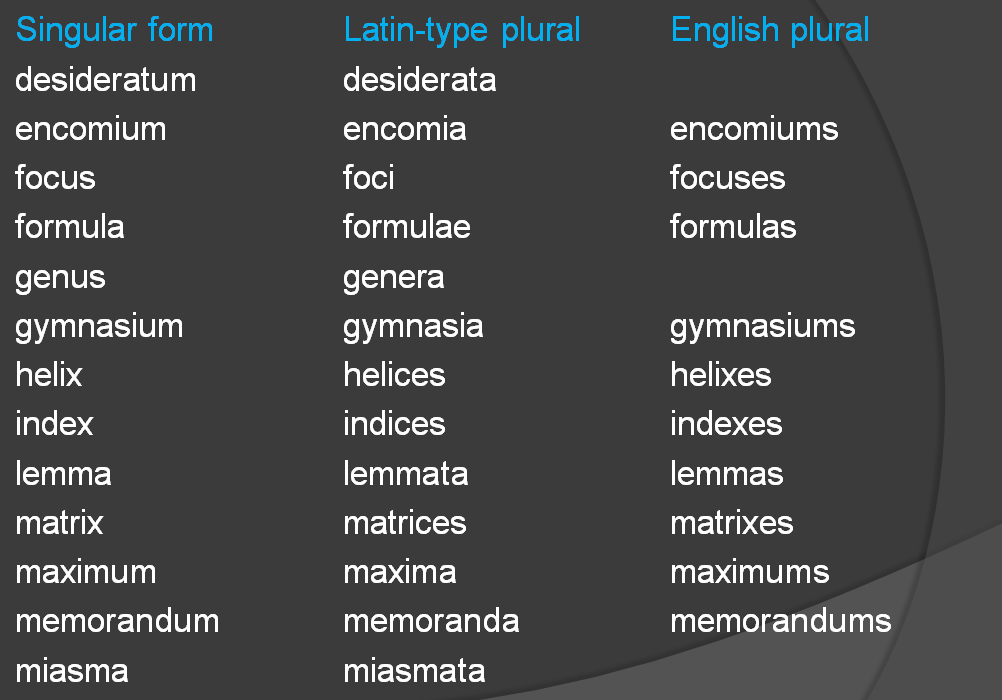
Useful Resources for Class 10 Lesson Wit and Humour (Greek and Latin Plurals)


  • Final a becomes -ae (also -æ), or just adds -s:
alumna alumnae
formula formulae/formulas
encyclopaedia (or encyclopædia) / encyclopedia encyclopaedias / encyclopedias (encyclopaediae and encyclopediae are rare)
Scientific abbreviations for words of Latin origin ending in -a, such as SN for supernova, can form a plural by adding -e, as SNe for supernovae.
  • Final ex or ix becomes -ices (pronounced /ɨsiːz/), or just adds -es:
index indices /ˈɪndɨsiːz/ or indexes
matrix matrices /ˈmeɪtrɨsiːz/
vertex vertices /ˈvɜrtɨsiːz/
Some people treat process as if it belonged to this class, pronouncing processes /ˈprɒsɨsiːz/ instead of standard /ˈprɒsɛsɨz/. Since the word comes from Latin processus, whose plural in the fourth declension is processūs with a long u, this pronunciation is by analogy, not etymology.
  • Final is becomes es (pronounced /iːz/):
axis axes /ˈæksiːz/
genesis geneses /dʒɛn.ə.siːz/
nemesis nemeses /ˈnɛməsiːz/
crisis crises /ˈkraɪsiːz/
testis testes /ˈtɛstiːz/
Axes (/ˈæksiːz/), the plural of axis, is pronounced differently from axes (/ˈæksɨz/), the plural of ax(e).
  • Final ies remains unchanged:
series series
species species

Miscellaneous irregular plurals

Some words have irregular plurals that do not fit any of the types given here.
person – people (also persons, in more formal contexts; people can also be a singular noun with plural peoples.)
die – dice (in the context of gaming, where dice is also often used as the singular; and also in the semiconductor industry. Otherwise dies is used.)
penny – pence (in the context of an amount of money in Britain).

Apophonic plurals

The plural is sometimes formed by simply changing the vowel sound of the singular (these are sometimes called mutated plurals):
foot feet
goose geese
louse lice
dormouse dormice
man men
mouse mice (computer mouse can also take the regular plural form mouses)
tooth teeth
woman women /ˈwɪmɨn/


Some can do either:
dwarf dwarfs/dwarves
hoof hoofs/hooves
elf elfs/elves
roof roofs (commonly voiced as /ruːvz/ to rhyme with hooves, but rooves is a rare archaic spelling)
staff staffs/staves
turf turfs/turves (latter rare)

Plurals of nouns in -o

With nouns ending in o preceded by a consonant, the plural in many cases is spelled by adding -es (pronounced /z/):
hero heroes (or heros)
potato potatoes
volcano volcanoes or volcanos
However many nouns of foreign origin, including almost all Italian loanwords, add only -s:
canto cantos
hetero heteros
photo photos
zero zeros
piano pianos
portico porticos
pro pros
quarto (paper size) quartos
kimono kimonos

Wednesday, March 19, 2014

New CCE Guide Lines for Class 10 Examinations in Andhrapradesh

Andhrapradesh State Government is planning to introduce new evaluation system(Focused on CCE) for class 10 from next academic year-2014-15.
  • Total number of papers reduced from 11 to 7
  • Each paper carries 100 marks (80 marks written examination + 20 Marks for formative assessment)
  • Pass marks 40
  • Out of 40 marks, they must get 30 marks in written examination to  pass the examination.
  • Most of the questions are open-ended to minimize the stress while learning(By-heart)
  • Marks scheme:
  • short answer questions:    
  1.  4Questions X 5marks =20 
  2.  10Questions X 3 marks =30
  3.  10 Questions X 2 marks =20
  4. 10 Questions X 1 marks = 10
  5. TOTAL       =                  80
FORMATIVE ASSESSMENT(Average of four formative Assessments): 20 Marks
                    5 Marks for Students responses(in class room group activities/group presentations)
                    5 Marks for Writing responses
                    5 Marks for Projects
                    5 Marks for Slip Test

New Grading System:
91-100  A1
81-90    A
71-80    B1
61-70    B
51-60    C1
41-50    C
0-39      D


Monday, November 5, 2012

SHORT SUMMARY OF HOUND OF BASKERVILLE


SHORT SUMMARY OF HOUND OF BASKERVILLE (Synopsis)
CLICK THE LINK FOR AUDIO


When Sir Charles Baskerville is found dead in the alley by the moor, Dr. Mortimer goes to London to get Sherlock Holmes’s help in deciding on the proper course of action for the new heir. He reads the manuscript about the family curse, supposedly begun over Hugo Baskerville’s inappropriate actions, and a newspaper article about Sir Charles’s death. After this, the doctor reveals that there is another piece of information-there were footprints of a hound a short distance from the fallen body. Holmes questions him over the details, wishing that he could have been called in earlier to examine the scene, but this was not possible, given the need for a tenant in the Hall and in the interest of preserving the doctor’s scientific reputation.

It is also told that Sir Charles appeared to be waiting for someone, though he was an elderly man; that his footprints showed he had been running away from the house in his fright; and that his heart was weak, so that he was to leave for London the next day. Though Holmes does not believe in the curse himself, he is intrigued by the case and agrees to meet the next day to discuss it.

Sir Henry (the heir) arrives from Canada and is already a little shaken. A note warning him to stay away from the moor was delivered at his hotel, where no one had known he would be staying. Holmes recognizes the cut-out letters from the previous day’s Times; being pressed for time, the sender had not been able to find the word “moor” and had handwritten it. The poor quality of the pen shows that it was written from a hotel, and the scent of perfume on the note points to a woman (this latter piece of evidence Holmes keeps to himself until the end). Sir Henry has also had a new boot stolen.

Once Sir Henry has been filled in, they make plans to meet again at the hotel later that day once he has had time to think, but it is clear that he will insist on going to Baskerville Hall. Holmes and Watson trail Sir Henry and Dr. Mortimer on their way back to the hotel, and discover that a man with a black beard (likely a fake) is following the pair in a cab. The cab drives off when the man discovers Holmes has spotted him, but the detective is able to get the cab number. Holmes then stops in at the messenger office and employs Cartwright to go around to the hotels, bribe the employees, and look through the wastepaper in search of a cut-up copy of the Times.

By the time they go to the hotel, Sir Henry has had another boot stolen, an old one now. When the first missing boot is discovered before the meeting is over, Holmes begins to privately realize they must be dealing with a real hound (hence the emphasis on the scent of the item). When conversation turns to the man in the cab, Dr. Mortimer says that Barrymore, the servant at Baskerville Hall, has a beard, and a telegram is sent to check on his whereabouts. The inheritance is also discussed-while it is a sizable amount, the next in line is James Desmond, an older man with few interests in wealth.

At the end of the meeting, it is decided that, Holmes being tied up in London with other cases, Watson will accompany Sir Henry to the Hall and report back in detail. Later that evening, telegrams from Cartwright (who was unable to find the newspaper) and Baskerville Hall (where Barrymore apparently is) bring an end to those leads. Also, a visit from John Clayton, who was driving the cab with the black-bearded man, is of little help. He does say that the man told him that he was the detective Holmes, much to the shock and amusement of the actual Holmes.

Dr. Mortimer, Watson, and Sir Henry set off for Baskerville Hall the next day. The baronet is excited to see it and his connection with the land is clear, but the mood is soon dampened. Soldiers are about the area, on the lookout for the escaped convict Selden, Barrymore and his wife want to depart from the area as soon as convenient, and the Hall is in general a somber place. Watson has trouble sleeping that night, and hears a woman crying, though the next morning Barrymore denies that this could be so.

Watson checks with the postmaster and learns that the telegram was not actually delivered into the hands of Barrymore, so it is no longer certain that he was at the Hall, and not in London. On his way back, Watson meets Stapleton, a naturalist familiar with the moor even though he has only been in the area for two years. They hear a moan that the peasants attribute to the hound, but Stapleton attributes it to the cry of a bittern, or possibly the bog settling. He then runs off after a specimen, but Watson is not alone for long before Miss Stapleton approaches him. Mistaking him for Sir Henry, she urgently warns him to leave the area, but drops the subject when her brother returns. The three walk to Merripit House (the Stapleton’s home), and during the discussion, Watson learns that Stapleton used to run a school. Though he is offered lunch and a look at Stapleton’s collections, Watson departs for the Hall. Before he gets far along the path, Miss Stapleton overtakes him and plays off her warning.

Sir Henry soon meets her and becomes romantically interested, despite her brother’s intrusions. Watson meets another neighbor, Mr. Frankland, a harmless man whose primary focus is on lawsuits. Barrymore draws increasing suspicion, as Watson sees him walk with a candle into an empty room, hold it up to the window, and then leave. Realizing that the room’s only advantage is its view out on the moor, Watson and Sir Henry are determined to figure out what is going on.

Meanwhile, during the day, Sir Henry continues to pursue Miss Stapleton until her brother runs up on them and yells angrily. He later explains to the disappointed baronet that it was not personal, he was just afraid of losing his only companion so quickly. To show there are no hard feelings, he invites Sir Henry to dine with him and his sister on Friday.

Sir Henry then becomes the person doing the surprising, when he walks in with Watson on Barrymore, catching him at night in the room with the candle. He refuses to answer their questions, since it is not his secret to tell, but Mrs. Barrymore’s. She tells them that Selden is her brother and the candle is a signal to allow him to get food. When the couple returns to their room, Sir Henry and Watson go off to find the convict, despite the poor weather and frightening sound of the hound. They see Selden by another candle, but are unable to catch him. Watson notices the figure of another man, but he likewise gets away.

Barrymore is upset when he finds out that they tried to capture Selden, but when an agreement is reached to allow Selden to escape out of the country, he is willing to repay the favor. He tells them about a mostly-burned letter asking Sir Charles to be at the gate at the time of his death. It was signed with the initials L.L. Dr. Mortimer tells Watson the next day that it could be Laura Lyons, Frankland’s daughter who lives in Coombe Tracey. When Watson goes to talk to her, she admits to writing the letter after Stapleton told her Sir Charles would be willing to help her, but says she never kept the appointment.

Frankland has just won two cases and invites Watson in, as his carriage passes by, to help him celebrate. Barrymore had previously told Watson that another man lived out on the moor besides Selden, and Frankland unwittingly confirms this, when he shows Watson through his telescope the figure of a boy carrying food off. Watson departs the house and goes off in that direction. He finds the dwelling where the unknown man has been staying, goes in, sees a message reporting on his own activities, and waits.

Holmes turns out to be the unknown man, keeping his location a secret so that Watson would not be tempted to come out and so he would be able to appear on the scene of action at the critical moment. Watson’s reports have been of much help to him, and he then tells his friend some of the information he’s uncovered-Stapleton is actually married to the woman passing as Miss Stapleton, and was also promising marriage to Laura Lyons to get her cooperation. As they bring their conversation to an end, they hear a scream, the sounds of a man being pursued by the hound.

They take off running and when they see the figure, they mistake it for Sir Henry. As their misery and regret grow, they realize it is actually Selden, dressed in the baronet’s old clothes (which had been given to Barrymore by way of further apology for distrusting him). Then Stapleton appears, and while he makes excuses for his presence, Holmes pretends to be returning to London.

Holmes and Watson return to Baskerville Hall, where over dinner, the detective realizes the similarity between Hugo Baskerville’s portrait and Stapleton. This provides the motive in the crime-with Sir Henry gone, Stapleton, the son of Rodger, could claim the Baskerville fortune. When they return to Mrs. Lyons’s place, they get her to admit to Stapleton’s role in the letter setup, and then they go to meet Lestrade.

Under the threat of advancing fog, Watson, Holmes, and Lestrade lie in wait outside the Merripit House, where Sir Henry has been dining. When the baronet leaves and sets off across the moor, the hound is soon let loose. It really is a terrible beast, but Holmes and Watson manage to shoot it before it can hurt Sir Henry. They discover Mrs. Stapleton imprisoned in the bedroom, and when she is freed, she tells them of Stapleton’s hideout deep in Grimpen Mire. When they head out the next day to look for him, they are not able to find him, and he is presumed dead.